AI: The Good, The Bad and The Ugly
The machine has no opinion. You do.
You've seen the headlines. AI is taking jobs. AI is writing novels. AI is targeting civilians. AI is diagnosing cancer. AI is generating child abuse material. AI is translating languages in real time for people who never had access to each other before. AI is being used to manipulate elections. AI is being used to overturn wrongful convictions.
All of it is true. All of it is happening simultaneously. And if you're trying to decide whether AI is good or bad, you're asking the wrong question.
The mirror nobody ordered
We built a technology that shows us exactly what we are. We did not plan for that part.
The sceptic is right
If you are afraid of AI, your fear is legitimate. Not because the technology is malevolent. Because the people and institutions deploying it are operating from the same range of intentions they always have.
Creativity: AI can now produce at scale what used to require years of craft. A graphic designer who spent a decade learning their discipline is competing with a prompt. The flattening of creative markets is real. The devaluation of craft is real.
Jobs: entire categories of work are being automated faster than the social systems built to absorb displacement can respond. It is happening in customer service, legal research, accounting, journalism, radiology, code. The people most affected are not the ones who built the systems. They rarely are. Power determines who absorbs the cost of disruption, regardless of the builder's intent.
Crime: the barrier to sophisticated fraud has collapsed. Deepfakes. Personalised phishing at scale. Disinformation campaigns that would have required armies of human operators now require one person and an API key.
War: autonomous weapons systems are making targeting decisions faster than human deliberation can follow. AI-assisted surveillance is enabling authoritarian governments to monitor and suppress dissent at a scale previously impossible.
Environment: the energy and water infrastructure required to run large AI systems is significant, growing, and largely invisible in the public conversation about what AI actually costs.
Every one of these concerns is real. Every one of them is an incomplete diagnosis.
The enthusiast is also right
Creativity: writers, musicians, designers, and thinkers working with AI are producing work they could not have produced alone. New forms are emerging. New voices are finding expression that the economics of traditional creative industries would never have supported.
Work: the work being automated is disproportionately the work that grinds people down. The repetitive, the administrative, the soul-destroying processing of information that humans were never well-suited to but were required to do anyway.
Justice: AI is identifying patterns of wrongful conviction in legal systems that lack the resources to review old cases manually. It is giving access to legal information to people who could never afford a lawyer. It is detecting systemic bias in sentencing data.
Medicine: diagnostic AI is identifying cancers at stages human clinicians miss. Drug discovery timelines that used to run to decades are compressing. AlphaFold's mapping of protein structures alone has compressed years of biological research into months.
Connection: people isolated by geography, disability, neurodivergence, language, or circumstance have access to thinking tools and communication that did not exist a decade ago. The arithmetic of who gets to participate in the full range of human intellectual and creative life is changing.
Every one of these possibilities is real. Every one of them is also an incomplete diagnosis.
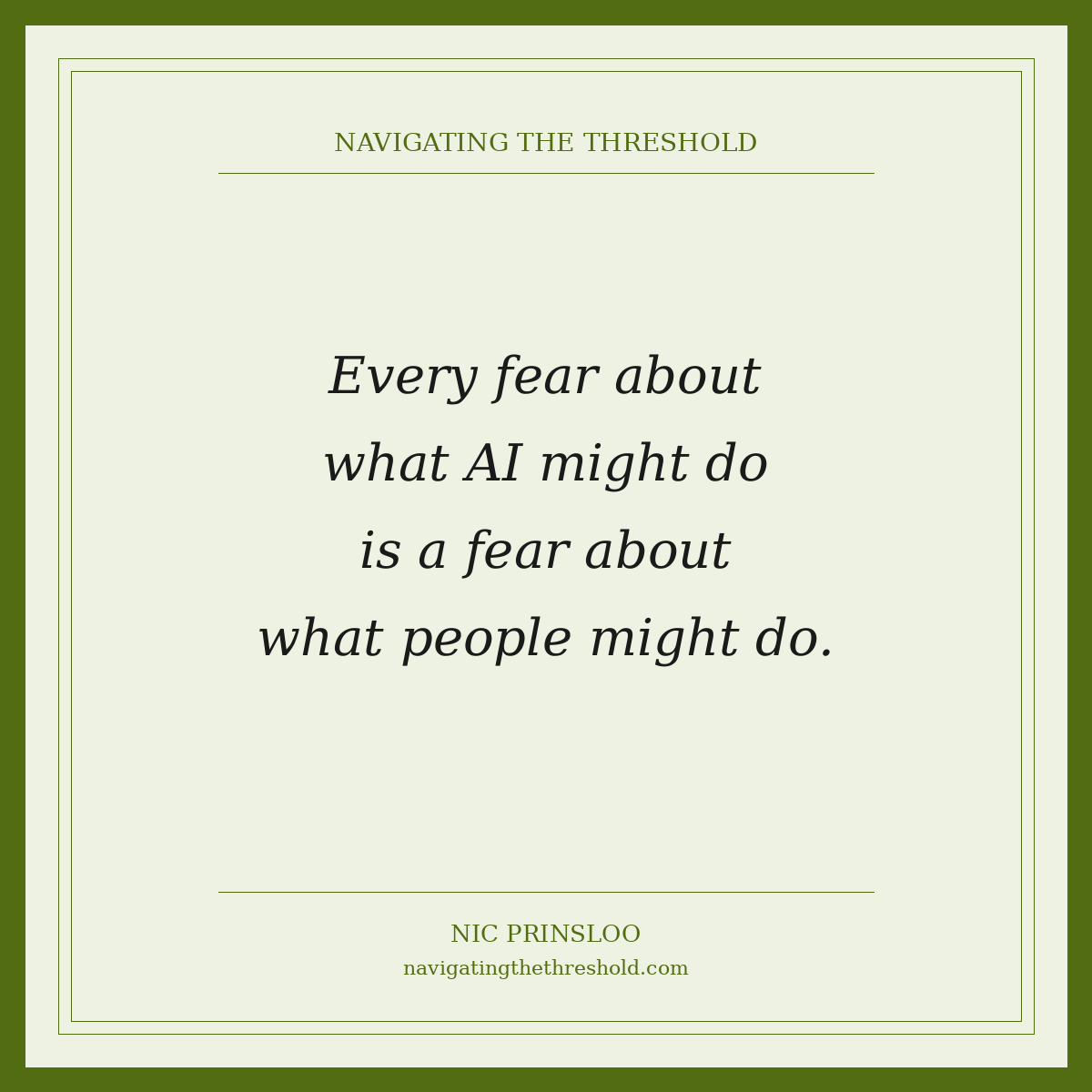
Every fear about AI is a fear about human beings. Every hope about AI is a hope about human beings. The technology is not the variable. We are.
The frame that holds both
Here is what the good and the bad have in common. They are produced by the same technology.
Which means the technology is not the variable.
AI in the hands of a weapons manufacturer accelerates war. AI in the hands of an oncologist accelerates healing. AI in the hands of a fraudster accelerates theft. AI in the hands of a poet accelerates beauty. AI in the hands of an authoritarian government accelerates oppression. AI in the hands of a human rights lawyer accelerates accountability.The tool does not choose. It amplifies what is already there.
Some will argue that autonomous systems change this. That when an algorithm makes a targeting decision or a content recommendation without a human present in the moment, the human is no longer the variable. But the human is upstream, not absent. Every autonomous system was designed by someone, oriented toward something, deployed by an institution with specific intentions. The intention does not disappear when the human steps back from the moment of execution. It is built into the architecture.
The problem, in every case where AI causes harm, is not the algorithm. It is the same problem it has always been. Human greed. Human indifference. Human hunger for power. Human failure to consider consequences. AI makes all of it faster. It does not introduce any of it.
The same is true of every case where AI enables something good. The goodness did not come from the machine.
Who is holding it. What are they already oriented toward.
The translation that runs through history
AI did not arrive from outside human history. It is the latest in a sequence that goes back to the first tool, the first fire, the first word pressed into clay.
Every technology humanity has built has been a translation of ourselves back to ourselves. Fire translated survival. Writing translated memory. The printing press translated knowledge. The internet translated connection. Each one amplified what was already in us. Each one was met with terror and wonder.
The Luddites were not wrong about what mechanisation would do to their livelihoods. They were right. The question was never whether the technology would disrupt. It always does. The question was what the people holding it would choose to do with the disruption.
AI is the most complete and fastest translation yet. Not a rupture in human history. A continuation of it. The disruption is not technological. It is revelatory.
What gets revealed
Previous technologies translated specific human capacities. AI translates everything simultaneously. How we think. How we create. How we decide. How we relate. How we fight. How we heal. Nothing is outside the translation. Nothing about human nature can be kept offstage anymore.
The laziness that was always there is now visible in what we ask AI to do for us. The creativity that was always there is now visible in what we build with it. The cruelty is visible in how it gets weaponised. The wisdom is visible in how it gets applied to problems we could not solve alone. The cowardice is visible in how institutions use it to avoid accountability. The courage is visible in how individuals use it to speak truth that would otherwise cost them too much.
AI is not changing human nature. It is revealing it. Faster than we are comfortable with. At a scale we cannot look away from.
The scary part is not the translation. It is what gets translated.
What are we oriented toward
If the technology is an amplifier and the variable is the human holding it, the question underneath every question about AI is this: what are we oriented toward.
Not as individuals only. As institutions. As cultures. As a species.
AI will accelerate whatever answer we give to that question. If the answer is extraction, it will extract faster. If the answer is healing, it will heal faster. If the answer is domination, it will dominate faster.
This is Ubuntu extended into the age of machine intelligence. We are what we are together. The tool is not separate from us. It is us, expressed at speed. The question was always the same question. AI just makes the answer more urgent and the consequences more immediate.
We translated ourselves into it. Now it is translating us back to ourselves. Clearer than we have ever been seen. Faster than we have ever moved. More consequential than any previous translation in human history.
Every fear about what AI might do is a fear about what we might do.
Every hope about what AI might enable is a hope about what we might become.
The machine has no opinion.
You do.
That was always the one big thing.